Listening Is Treatment Too: Why Australia's Mental Health Nurses Are Having Their Moment
Something is shifting in how Australia understands what actually makes mental health care work, and for the millions of Australians who move through our mental health services each year, the timing could not be better. New international research has put a measurable number on something mental health nurses have understood for generations. The relationship between a nurse and a patient is not a soft extra around the edges of treatment. It is part of the treatment itself. Patients who feel heard, safe and genuinely involved tend to recover better, and in at least one well-designed study they went home sooner. Australia already has the clinical frameworks, the credentialing pathway and the professional standards to lead on this. What it needs now is the workforce, and that is where the opportunity sits. This is a moment for mental health nursing. And mental health nurses are right at the centre of it.
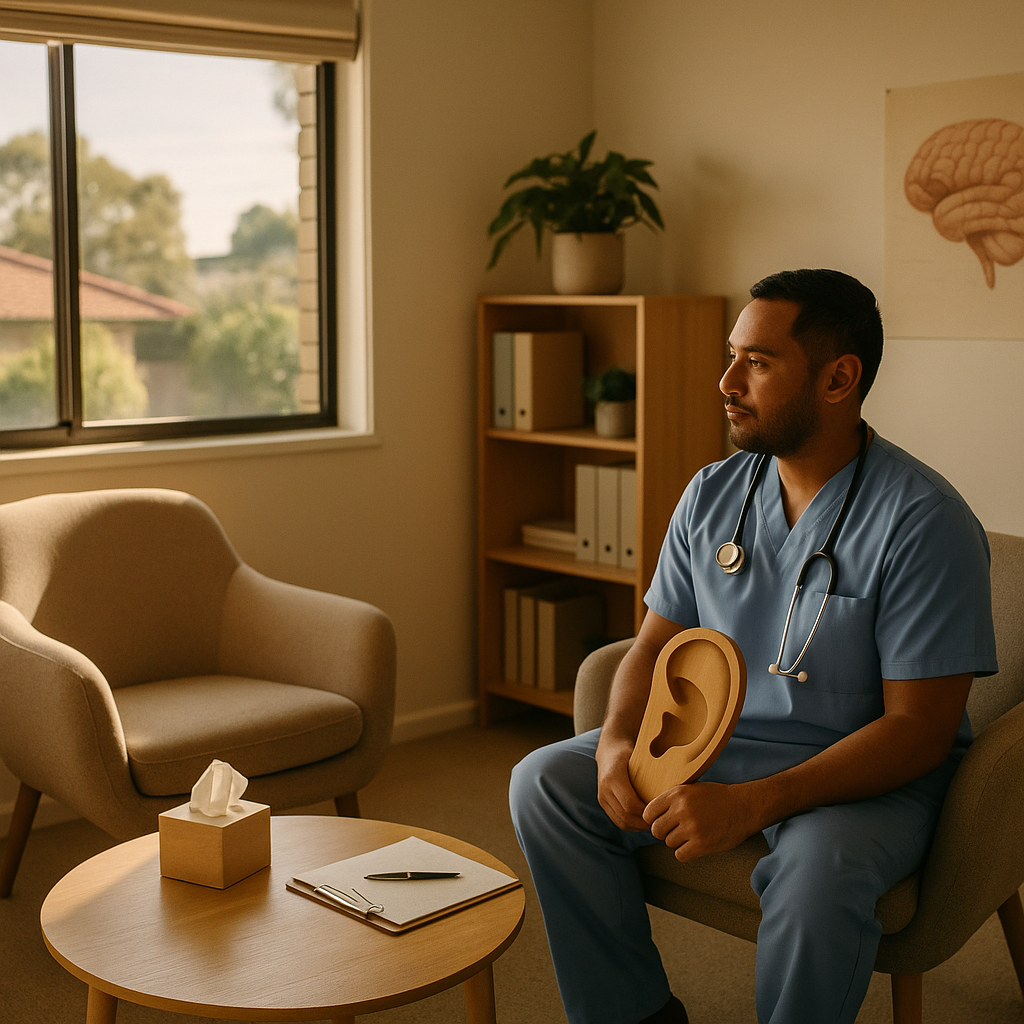
Something is shifting in how Australia understands what actually makes mental health care work, and for the millions of Australians who move through our mental health services each year, the timing could not be better.
For a long time, the bond between a nurse and a patient was filed under the human or ethical side of healthcare. Important, certainly. Measurable, not really. That assumption is now being challenged by evidence, and the implications for Australia's mental health workforce are genuinely encouraging.
This is a moment for mental health nursing. And mental health nurses are right at the centre of it.
New Evidence Is Putting a Number on Something Nurses Always Knew
Being admitted to a mental health unit can be one of the most vulnerable moments in a person's life. People often arrive in crisis, frightened and confused. A recent piece published in The Conversation reported on research carried out across 12 Spanish mental health units, and the findings are striking.
The researchers looked at how patients and nurses each perceived the therapeutic relationship in the first days after admission. Nurses tended to rate the relationship positively. Patients were often less satisfied, and three things drove the gap: communication, trust and being able to participate in decisions about their own care. When patients felt heard, understood what was happening to them, and had a real say in their treatment, they reported less fear, less humiliation and a stronger sense of safety.
The team then tested a simple, structured intervention they called a "Reserved Therapeutic Space". It was protected time for the nurse and patient to talk without interruption, identify concerns, agree on goals and prepare for discharge. Patients who received it rated their care more highly, especially around participation and discharge readiness. They also reported fewer feelings of coercion and fear. And on average, according to the study, they were discharged several days sooner than patients who received usual care.
A note on honesty here, because it matters. This is a Spanish study, not an Australian one, and it reports an average reduction of "several days" rather than a single precise figure. So it is best read as strong supporting evidence rather than a local statistic. But the direction of travel is clear, and it lines up with a much larger body of work. A systematic review of interventions to improve the therapeutic alliance in mental health nursing confirms this is an active, serious field of research internationally, not a fringe idea.
The optimistic read is simple. A better relationship was not just kinder. It was measurably better care, and quite possibly faster and less costly care too.
The Relationship Is the Intervention
If that finding feels intuitive to anyone who has worked a ward, that is because it is woven into the way the profession defines itself in this country.
The Australian College of Mental Health Nurses, the peak professional body for the discipline, describes mental health nursing as "therapeutic in itself", grounded in a caring, honest and trusting relationship. That is not a marketing line. It is the professional foundation of the work.
It is reflected in the ACMHN Standards of Practice, which set the expectation that a mental health nurse develops a therapeutic relationship respectful of the individual's choices, experiences and circumstances, building on strengths, holding hope and enhancing resilience to promote recovery. In other words, the recovery-oriented, person-centred relationship is not an optional flourish on top of clinical care. In Australian mental health nursing, it is the standard.
What the new research adds is external validation. The thing the profession has always treated as central turns out to have measurable effects on how safe patients feel, how much they participate in their own treatment, and how their admission progresses. That is a powerful position for any profession to be in.
Australia Already Has the Framework
Here is the genuinely good news. Australia is not starting from scratch on any of this. The infrastructure already exists.
The ACMHN administers the Credentialed Mental Health Nurse (CMHN) credential, Australia's nationally recognised qualification that validates specialist expertise in mental health nursing. Credentialed Mental Health Nurses can deliver specialised, recovery-oriented care, and in many settings that includes work funded through Medicare arrangements via Primary Health Networks. There are postgraduate education pathways, national standards, and a clear professional identity for nurses who want to specialise.
So the question facing the sector is not "how do we invent a model of relational mental health care". It is "how do we grow and support the workforce that already knows how to deliver it". That is a far more solvable problem, and a far more hopeful one.
The Workforce Picture, and the Opportunity in It
The demand side of the equation is not in doubt. Around one in five Australian adults experiences a mental disorder in any given year, a figure drawn from national mental health and wellbeing data, and demand for skilled mental health care continues to climb.
On the supply side, the numbers tell a story of steady growth that still has room to run. According to the Australian Institute of Health and Welfare, there were about 40,900 full-time-equivalent staff working in specialised mental health care facilities across Australia in 2023 to 2024. Nurses consistently make up the largest single group of that workforce, rising from roughly 16,030 FTE in 2014 to 2015 to almost 20,240 FTE in 2023 to 2024. That is meaningful, sustained growth in exactly the workforce this evidence points to.
A word of precision, because the business of healthcare runs on accurate numbers. That 20,240 figure counts nurses in specialised mental health facilities specifically, not every nurse delivering mental health care across the whole system, so it understates the true mental health nursing footprint rather than overstating it. Separately, the National Mental Health Commission reported a rate of about 97 mental health nurses per 100,000 population in 2021, which is useful for tracking the trend over time. Treat the 2021 rate as a reference point rather than today's exact figure.
Now the demand pressure. The AIHW's health workforce reporting found that more than four in five health professional occupations (around 82 per cent) were in shortage in 2023, with mental health roles and registered nurse occupations squarely on that list. Workforce modelling reported by the Australian Nursing and Midwifery Journal projects a national undersupply of more than 70,000 full-time-equivalent nurses by 2035, with mental health named as one of the five sectors modelled and one of those under real strain. That 70,000 figure is a projection from a model rather than a current headcount, so it should be read as a forward-looking warning, not a present-day count.
Put the two halves together and you get the opportunity in plain terms. There is rising demand, robust evidence that skilled relational care works, and a workforce that is growing but not yet keeping pace with need. For a mental health nurse weighing up the next decade, that is about as favourable a set of conditions as a profession can offer.
Where the Opportunity Is Greatest
The need is not spread evenly, and that is worth understanding clearly. Analysis of the AIHW's specialised mental health workforce data, summarised in a 2025 commentary in Australasian Psychiatry, found that there are generally fewer mental health workers the further you travel from the major cities. Interestingly, mental health nurses and psychologists were among the better-distributed mental health professions in rural areas, which means mental health nursing is already carrying a significant share of care outside the metro centres.
For nurses who want their work to count where it is needed most, regional and remote Australia is not a consolation prize. It is some of the most impactful, autonomous and respected work in the discipline, and it is where a single skilled practitioner can change the shape of care for an entire community.
This Is a Career-Defining Moment for Mental Health Nurses
For mental health nurses thinking about their next move, the pieces are lining up in a way they rarely do all at once. The evidence base is strengthening. The professional standards already centre the relational skills that nurses are trained in. The credentialing pathway exists. The demand is real and growing. And the cultural conversation is finally catching up to the value of the work.
Whether that next move is a specialist inpatient role, a community mental health setting, a credentialed mental health nurse pathway, or a regional position where the impact is outsized, the conditions have rarely been more favourable. The sector does not just need more nurses. It needs the nurses who understand that listening, building trust and sharing decisions is clinical work, not the nice-to-have around it.
MediRecc is actively connecting mental health nurses, including registered nurses, enrolled nurses and credentialed mental health nurses, with hospitals, community services and mental health groups across Australia. Whether you are a practitioner looking for your next role, or a service building out your mental health team, the infrastructure to make that match efficiently is here. Every professional on the platform is AHPRA verified, and posting a role is free.
The evidence is clear. When people are listened to, trusted and treated as central to their own care, they have a better experience and, often, a better recovery. Australia already has nurses who know how to deliver that. The job now is making sure we have enough of them, and that we give them the time and conditions to do their best work.
The momentum is building. The only question is how quickly we choose to move.
MediRecc is Australia's purpose-built healthcare recruitment marketplace, spanning medical and general practice, surgical, allied health, diagnostic and pathology, dental, aged care and rehabilitation. Browse mental health nursing opportunities or list a role with us today.
Further reading
- The Conversation: Better patient-nurse relationships can transform mental health care
- Australian College of Mental Health Nurses (ACMHN)
- ACMHN Standards of Practice
- AIHW: Specialised mental health care facilities
- AIHW: Health workforce
- ANMJ: Australia facing a nursing shortfall by 2035
- Systematic review: improving the therapeutic alliance in mental health nursing (PMC)